From Colony to Strategic Crossroads
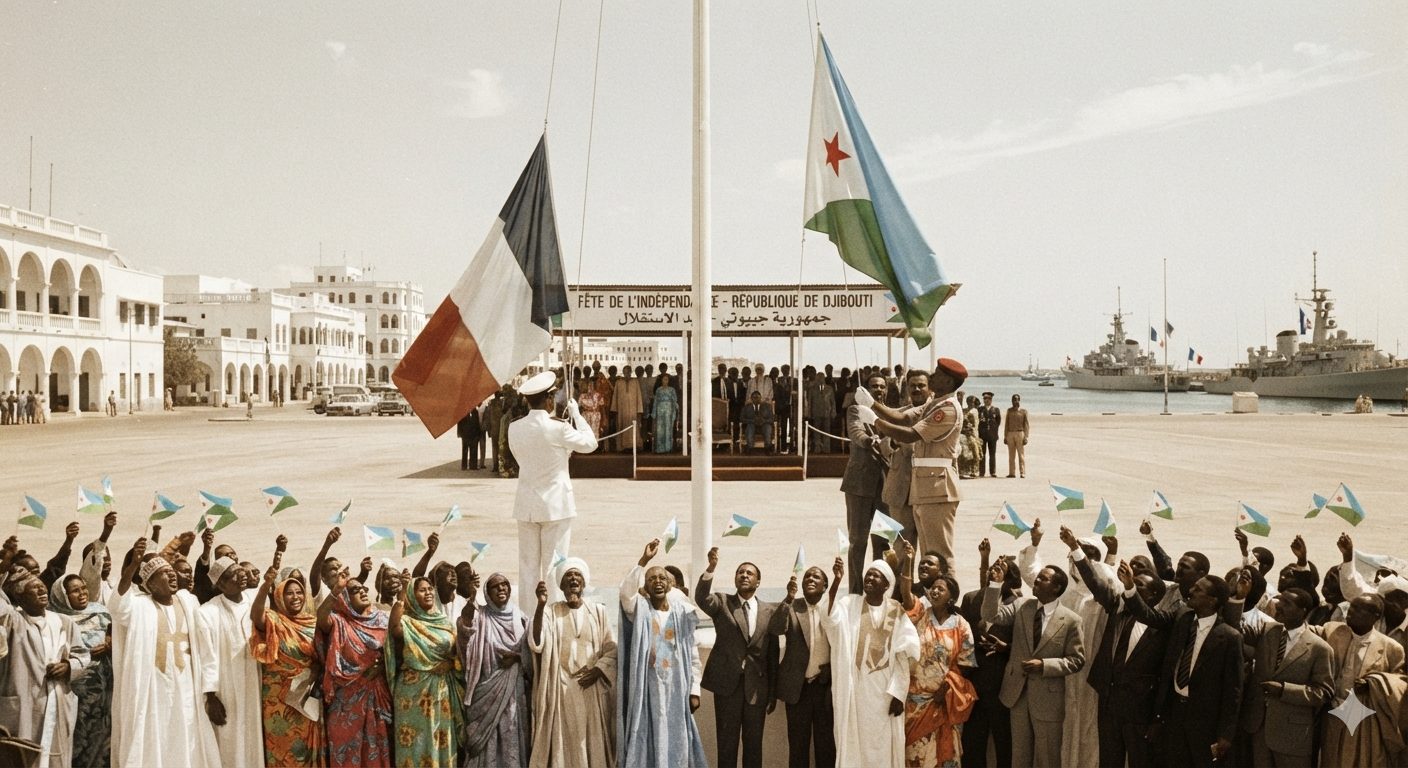
From Colony to Strategic Crossroads: Djibouti’s Journey Since Independence
Djibouti achieved independence from France on June 27, 1977, becoming one of the final African nations to gain sovereignty in the 20th century. Over the past five decades, this small yet pivotal Horn of Africa state has evolved from a fractured post-colonial territory riven by ethnic tensions into a remarkably stable and indispensable hub for global trade and international military operations.
The Birth of a Nation (1977–1981)
Prior to independence, the territory was known successively as French Somaliland and later the French Territory of the Afars and the Issas. Colonial rule had long exploited and exacerbated ethnic divisions between the two principal groups: the Somali-affiliated Issa and the Afro-Asiatic Afar.
After two contested referendums failed to resolve the future status, a historic third vote on June 27, 1977, delivered an overwhelming 98.8% in favour of independence. Hassan Gouled Aptidon, an Issa leader, became the nation’s first president. In its nascent years, Djibouti faced immense challenges: regional instability from neighbouring Ethiopia and Somalia, alongside the precarious task of balancing inter-ethnic power-sharing a promise that would prove difficult to uphold.
One-Party Rule and Civil War (1981–2000)
The initial vision of inclusive governance gave way to consolidation of power:
• 1981: President Aptidon declared his party, the Rassemblement Populaire pour le Progrès (RPP), the sole legal political entity establishing a one-party state.
• 1991: Deep grievances among the Afar population erupted into armed rebellion under the Front for the Restoration of Unity and Democracy (FRUD), igniting a devastating civil war in northern Djibouti.
• 1992: Under mounting domestic and international pressure, a new constitution introduced a limited multi-party system.
• 2000: A definitive peace accord between the government and FRUD’s radical faction formally ended the conflict, cementing a fragile but enduring national reconciliation.
The Guelleh Era and Strategic Transformation (1999–Present)
In 1999, Aptidon peacefully transferred power to his nephew, Ismaïl Omar Guelleh a transition that marked the beginning of Djibouti’s strategic reorientation. Leveraging its unmatched geographic position astride the Bab el-Mandeb Strait, the world’s busiest maritime chokepoint and gateway to the Suez Canal, Djibouti transformed itself into a regional logistics powerhouse.
Key developments include:
• The modernisation of the Port of Djibouti as the principal maritime lifeline for landlocked Ethiopia.
• The 2017 launch of the Ethiopia–Djibouti Electric Railway, a $4 billion electrified corridor that dramatically improved freight efficiency and regional integration.
A Global Military Nexus
Djibouti’s domestic stability relative to its volatile neighbourhood has made it a preferred host for foreign military presence. Today, it uniquely shelters bases from multiple global powers:
• 🇺🇸 United States: Camp Lemonnier, the only permanent U.S. base in Africa.
• 🇨🇳 China: Its first overseas military support facility, opened in 2017.
• 🇫🇷 France, 🇯🇵 Japan, and 🇮🇹 Italy: Each maintaining dedicated operational installations.
Modern Challenges Amidst Opportunity
While Djibouti generates substantial revenue from foreign base leases and port fees, its economic gains remain unevenly distributed:
• The nation ranks low on the Human Development Index (HDI).
• Youth unemployment remains persistently high.
• Heavy reliance on external borrowing has raised concerns about debt sustainability.
Yet, despite these domestic pressures, Djibouti enters its fiftieth year as an independent nation a vital anchor of peace and commerce in one of the world’s most volatile regions.
Let me know if you'd like this adapted further—for a presentation, report, or video script!
0 comments
Leave a comment